By Samah Sabawi
First Published Oct 14, 2026 Pedestrian TV
Five millennia of continuous urban life. That’s how my baba used to boast about the only city he ever loved. Gaza. Ancient and resilient. When we were children, my brother and I spent an entire summer excavating in the garden of our grandfather’s home after learning that the soil beneath Gaza held treasures that went further back than the Bronze Age. We didn’t recover ancient treasure, but we learned how precious the soil was that sprung the pomegranates, the lemons, the figs, the tomatoes and the almonds that we feasted on.
We understood what it meant to belong to a city that belongs to five thousand years of continuous life.
That continuity is what makes the present moment so terrifying.
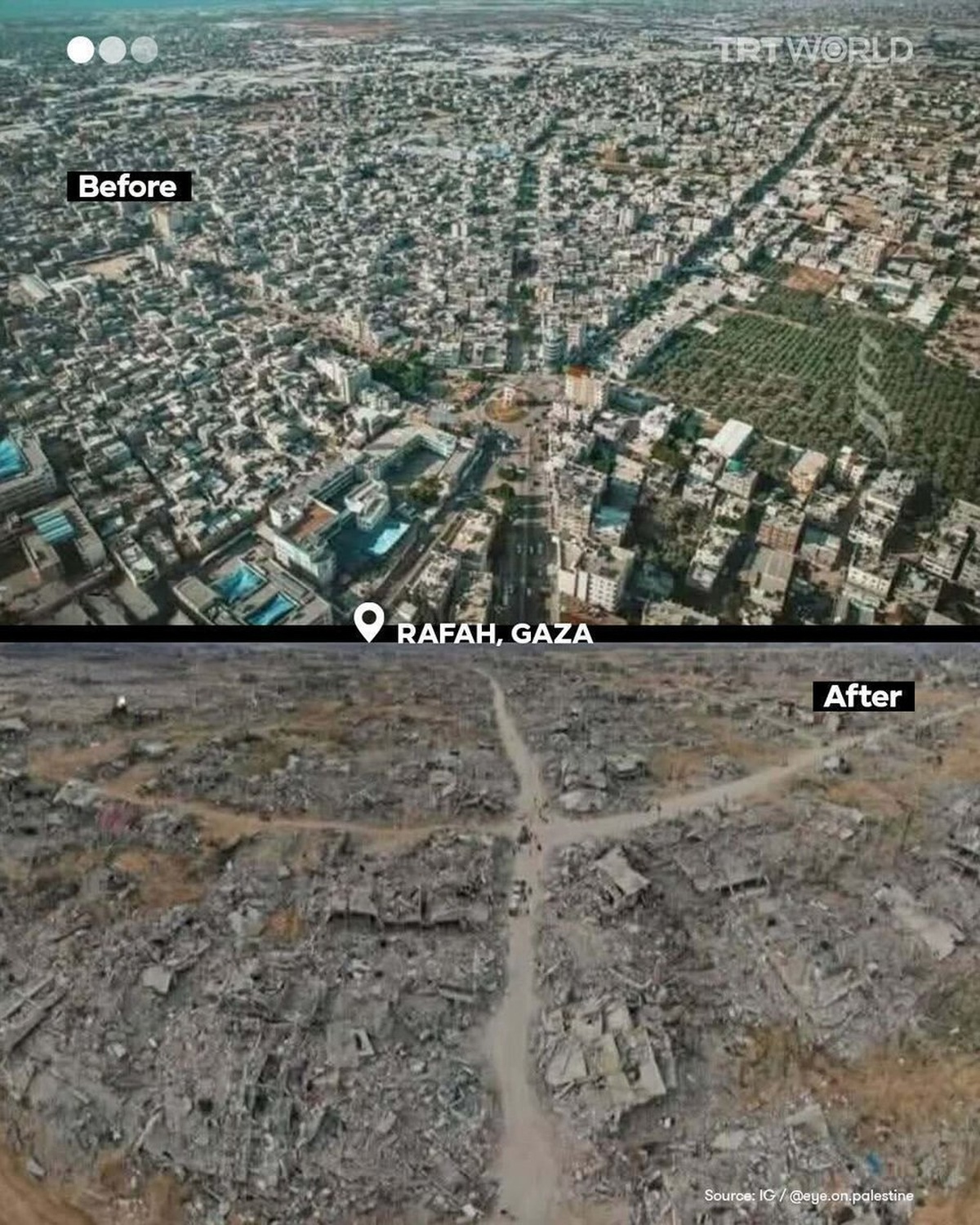
The devastation of Gaza threatens not only its capacity to sustain life, but threatens the destruction of material record of thousands of years of human history.
This did not begin on October 7, 2023. For decades, Israel deliberately and progressively diminished Gaza’s capacity to sustain human life. The recent shocking satellite images of Gaza that dominated our newsfeed are only the latest chapter in a story that began in 1948 when the Zionist movement, headed by newly arrived Jews from Europe, sought to establish a Jewish state on Palestinian land. Two thirds of the Palestinian population were terrorised by Jewish gangs and forcibly driven from their homes that were later stolen by the Jewish settlers. 200,000 of the Palestinians who fled ended up in Gaza, which back in 1948 fell outside the borders of the newly formed Israel.
In 1967, Israel occupied Gaza, the West Bank and East Jerusalem. Its military occupation placed restrictions on Palestinian land, movement, water, trade, borders and natural resources, weakening Palestinian economic independence while exploiting the riches of their land. UNCTAD calls this process “de-development”: development not merely obstructed, but reversed.
Gaza, now known internationally for death, rubble and starvation, was not only once rich with historic treasures and endless acres of agricultural land, it also sits beside a natural-gas field that contains an estimated 1.4 trillion cubic feet of gas that Israel has prevented Palestinians from developing.
In 2007, Israel placed a siege on Gaza that resulted in a humanitarian crisis. In 2012, the UN published a report that now reads like a prophecy: Gaza in 2020: A Liveable Place? At the time, 90 percent of water from Gaza’s coastal aquifer was already unsafe to drink. In 2017, the UN found that conditions had deteriorated “further and faster than anticipated.”
Still, Gaza was a miracle of living. In August, 2023, I visited Gaza and saw universities brimming with young, inquisitive minds; musicians performing concerts by the sea; farmers harvesting, poets writing, artists painting, and intellectuals debating as young couples secretly dated and parents juggled a life work balance. This extraordinary ability to survive and even thrive, was never proof that the conditions imposed upon them were liveable. It proved only how remarkable they were at cultivating life.
Maybe five thousand years of making life in Gaza had taught them how.
Sadly, since 2023, we witnessed the violent acceleration of a much longer history of displacement, dispossession and de-development into something even more dangerous: ecological devastation.
In 2025, the UNEP estimated that Gaza contained 61 million tonnes of debris. Around 15 percent potentially posed relatively high contamination risks from asbestos, industrial waste or heavy metals. Gaza had lost approximately 97 percent of its tree crops, 95 percent of its shrubland and 82 percent of its annual crops.
This is the definition of genocide, the intentional destruction of the capacity to sustain life. In September 2025, the International Association of Genocide Scholars concluded that Israel’s policies and actions in Gaza meet the legal definition of genocide under the 1948 Genocide Convention.
Still, Australia welcomed Israeli President Isaac Herzog as an official guest in February 2026 despite Amnesty International Australia calling on the government to investigate him for genocide and pointing to statements it says amount to genocidal incitement.
A 2025 report by the UN Special Rapporteur also identified Australia among the states participating in the global supply chain for components and parts for the F-35 programme, aircraft used extensively by Israel in Gaza.
Gaza exposes how universal legal guardrails are cast aside when enforcement collides with the interests of powerful states. It also exposes the fragility of environmental guide rails as the world turns a blind eye to the ecological disaster Israel has produced. Although these crimes have been extensively documented, the international response, save expressions of grave concern, legal action and measures taken by some states, has imposed few meaningful consequences on Israel. Instead, we are watching a global order being reshaped in ways that allow such destruction to continue.
Often when discussing climate change, we talk about Earth as one interconnected ecological system. But nationalist movements, including Zionism, see the Earth as borders, conquests and resources that override the human rights of those who fall outside their national definition. Nationalist movements hold the pursuit of increasing corporate profits and economic gain within territorial spaces ahead of human life and the environment. Land is disposable. The people living on it are disposable too.
But, a poisoned aquifer remains part of our planet. Contaminated soil remains Earth. A devastated coastline does not disappear from the global ecosystem because its inhabitants have been politically abandoned. The devastation of Gaza will not stop in Gaza. Every inch of Earth is our planet.
Leave a Reply